


Comparing the Impact of Mailed Notices from Different IRS Distribution Systems

Summary
Ensuring consistent and effective communication with tax preparers and their clients is crucial for promoting tax compliance. This evaluation examined the impact of mailed notices distributed through two different IRS systems. The results suggest the distribution method did not change the impacts of the notices on tax compliance.
Agency Priority
The Internal Revenue Service (IRS) Return Preparer Strategy (RPS) is an agency-wide effort to reduce errors made by paid tax return preparers in claiming refundable tax credits and other tax benefits. These include the Earned Income Tax Credit (EITC), the Additional Child Tax Credit (ACTC), the American Opportunity Tax Credit (AOTC), and Head of Household filing status. Compliance with rules around correctly claiming benefits is encouraged by providing targeted outreach and education to preparers whose filed returns have a high proportion of likely errors. The IRS RPS is interested in the feasibility of using letters/notices sent through online accounts (OLA), as opposed to the business-as-usual method of distribution via standard (USPS) mail through the National Distribution Center (NDC), as a potential means of cost savings.
What We Evaluated
As part of their tiered strategy to improve the accuracy of claiming certain tax benefits, the IRS conducts outreach and education to paid tax return preparers and their clients. We partnered with the IRS to evaluate the impacts of two letters: a tax preparer letter, sent to high-risk tax preparers prior to the filing season, and a client letter, also sent prior to the filing season, sent to clients of a different set of tax preparers. We embedded an additional evaluation within each of the individual letter evaluations to assess whether sending the letters through OLA would be as effective as sending them through the NDC.
Preparers (N = 3,686) and clients (N = 8,826) who had been randomly assigned to be sent letters, and who had signed up for online accounts prior to the start of the evaluations, were randomized to be sent the letters either online via the OLA system (n = 1,843 preparers; 7,128 clients) or mailed through the NDC (n = 1,843 preparers; 1,698 clients). However, due to logistical constraints, the OLA letters were not able to be delivered online, and were instead sent via standard mail. Thus, we compared the effects of two similar letters that were delivered via standard (USPS) mail, but sent from two different distribution systems within the IRS.
We used administrative data maintained by the IRS, plus tax return-level data processed by the IRS’s Taxpayer Services Division, to construct the outcomes. The outcomes were measured using data from returns filed during the 2025 filing season. For preparers, the outcome was an indicator for whether the preparer continued to prepare enough returns with likely errors to make them eligible for additional outreach during the filing season. For clients, the outcome was the dollar amount of refundable tax credits (EITC, ACTC, and AOTC) claimed with likely errors.1
What We Learned
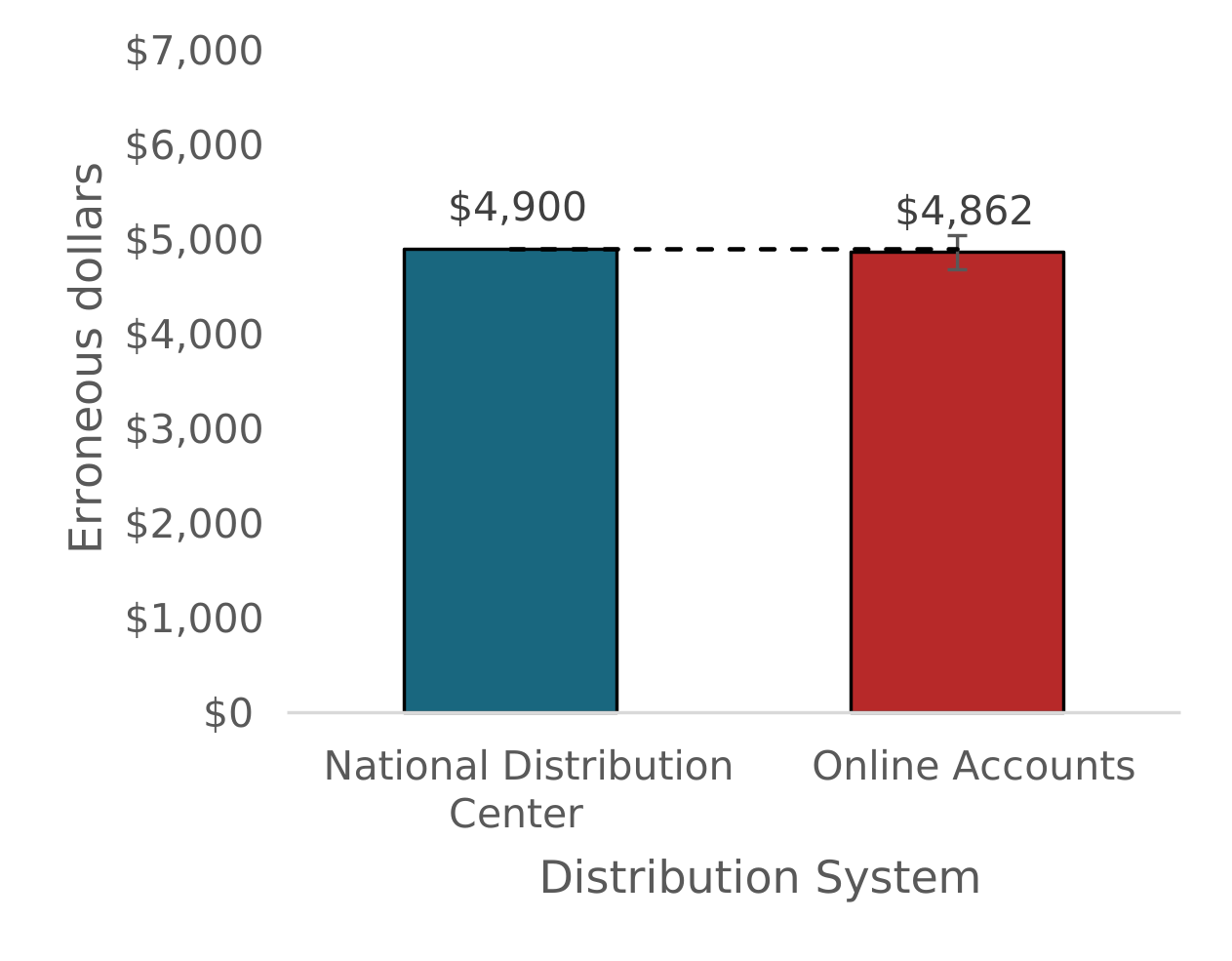
For both tax preparers and clients, we found that there were no differences in effects across the distribution systems. Among tax preparers, 48.1% of those who were sent letters via NDC submitted enough returns with likely errors to be eligible for filing season outreach, compared to 49.3% of preparers sent letters via OLA, but this difference is not statistically different from zero (p = .43, 95% CI [-1.8%, 4.3%]). Among clients of tax preparers, the average erroneous dollar amount was $4,900 among clients sent letters via NDC and $4,862 among clients sent letters via OLA, and this difference is not statistically significant (p = .68, 95% CI [-218, 143]).2
Figure 1
Sending Preparer Letters via the OLA or NDC Distribution Systems Did Not Impact the Likelihood That Preparers Would Continue to Prepare Enough Returns with Likely Errors During the Filing Season to Be Eligible for Outreach
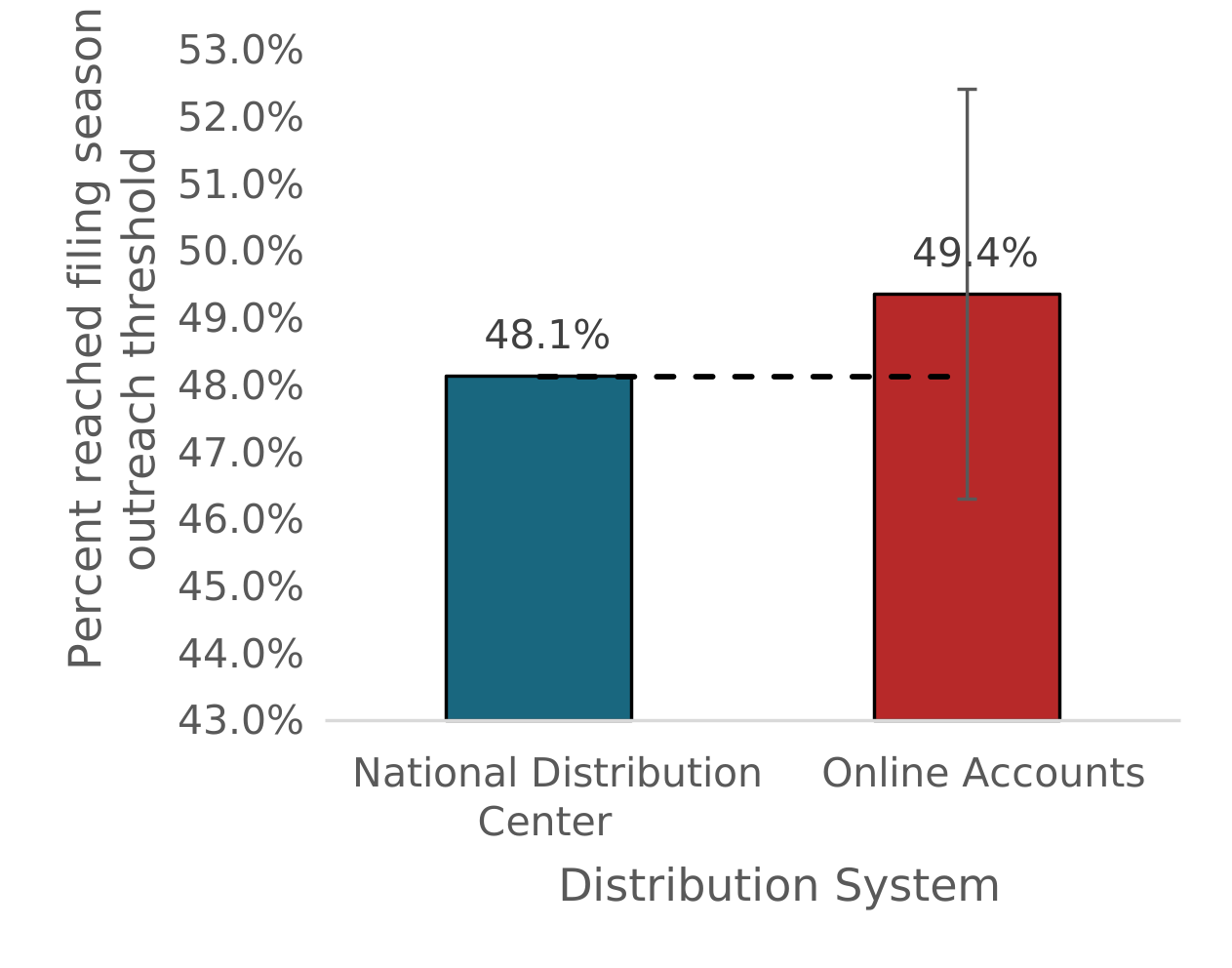
Figure 2
Sending the Client Letters via the OLA or NDC Distribution Systems Did Not Impact Erroneous Dollars from Tax Credits Claimed with Likely Errors
Applying the Findings
Evaluation results showed no statistically significant differences in tax compliance outcomes between the clients and preparers mailed notices via different IRS distribution systems (OLA and NDC). This consistency across distribution systems suggests that the IRS’s messaging is robust and effective, regardless of the specific channel used to distribute it via mail.
It is important to note that this evaluation did not directly compare online and mailed notices, as was originally intended, so we cannot draw conclusions about the relative effectiveness of these two methods. Additional evaluations are needed to understand the potential benefits and drawbacks of online notice methods.
Notes:
- Refundable tax credits include the American Opportunity Tax Credit (AOTC), Additional Child Tax Credit (ACTC), and Earned Income Tax Credit (EITC).
- An IRS internal report on this project gives results based on using refund amount as the outcome for clients, instead of erroneous dollars.