


Reducing Reporting Errors via Outreach to Tax Preparers and Clients

Two people reviewing tax forms
Summary
- The goal of this evaluation was to compare two strategies for improving tax compliance among clients of high-risk tax preparers - (a) sending warning letters to preparers’ clients and (b) conducting outreach directly to preparers. We had two key motivating questions. First, we wanted to learn whether sending letters to some clients of a tax preparer could affect the behavior of the preparer’s other clients. If so, the IRS could achieve meaningful compliance gains while mailing fewer letters, thus reducing program costs.
- Second, we wanted to understand who should receive outreach to have the biggest impacts on tax return accuracy and potential cost savings - preparers, or preparers and their clients simultaneously.
- We found that sending letters to clients reduced the dollar amount of likely errors when claiming tax credits by $209 on average, but only among clients who were sent the letter directly — we observed no effects on “spillover” clients not sent letters. Letters and phone calls to preparers alone had no impact, but there is (statistically imprecise) evidence that combining the letters and calls to preparers with letters to their clients does improve tax compliance. Overall, we conclude that sending letters to clients of preparers can reliably improve tax compliance.
Agency Priority
In 2023, the Internal Revenue Service (IRS) estimated that there were over $24 billion dollars in overpayments from three high-priority refundable tax credit programs: the Additional Child Tax Credit (ACTC), American Opportunity Tax Credit (AOTC), and the Earned Income Tax Credit (EITC). Individual tax filers (“clients”) often use paid tax return preparers to help prepare their returns. The IRS, through their Return Integrity and Compliance Services - Return Preparer Strategy (RPS), aims to improve compliance and reduce overclaims of refundable tax credits among tax preparers and their clients through education and outreach.
IRS outreach includes a letter to tax filers, which the IRS sends to individuals (clients) who (a) used a tax preparer during the previous tax season who was identified as preparing returns with likely errors (“high-risk” preparers), and (b) who had likely errors in their own tax return. This client letter is sent in the winter before the tax season. It informs the client that their previous return may have contained errors, and encourages them to find a different way to prepare their taxes in upcoming tax seasons. In a previous evaluation, we found that the client letter in reducing likely filing errors.
How We Evaluated
We conducted two evaluations to answer two separate but related policy questions:
- Client Letter evaluation: Can sending letter outreach to some clients influence other clients who used the same tax preparer, achieving compliance gains while reducing program costs? If so, is the cost-benefit tradeoff improved by sending letters to a larger or smaller share of a preparer’s clients?
- Preparer Outreach evaluation: Can we improve compliance more by targeting outreach only to preparers (in the form of a letter followed by a phone call) or by targeting outreach to both preparers and their clients?
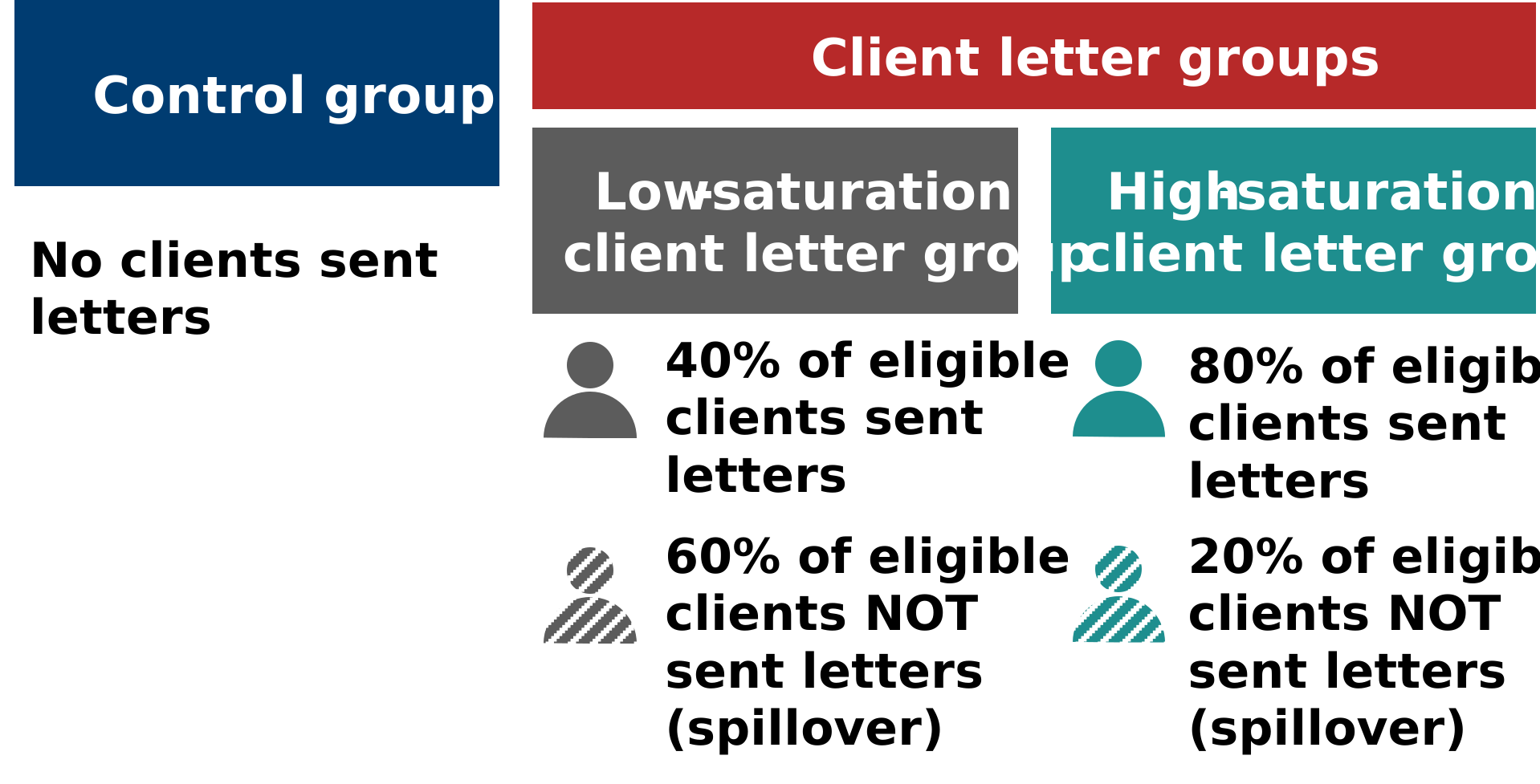
In the Client Letter evaluation, we randomized tax preparers into one of three outreach groups: (a) a control group with no outreach to the preparer or the preparer’s clients (n = 180 preparers, 9,192 clients); (b) a high-saturation client letter group (n = 379 preparers, 18,515 clients); and (c) a low-saturation client letter group (n = 371 preparers, 19,090 clients). In the high-saturation client letter group, 80% of the preparer’s eligible clients were randomly assigned to be sent the letter; in the low-saturation client letter group, 40% were assigned to be sent the letter.1 The remaining eligible clients—20% in the high saturation group and 60% in the low saturation group—were not sent the letter and are referred to as “spillover” clients. Analyzing outcomes for these clients allows us to test whether the effects of the letters “spilled over” to other clients who used the same preparer.
Figure 1
Client Letter Evaluation Randomization Procedure
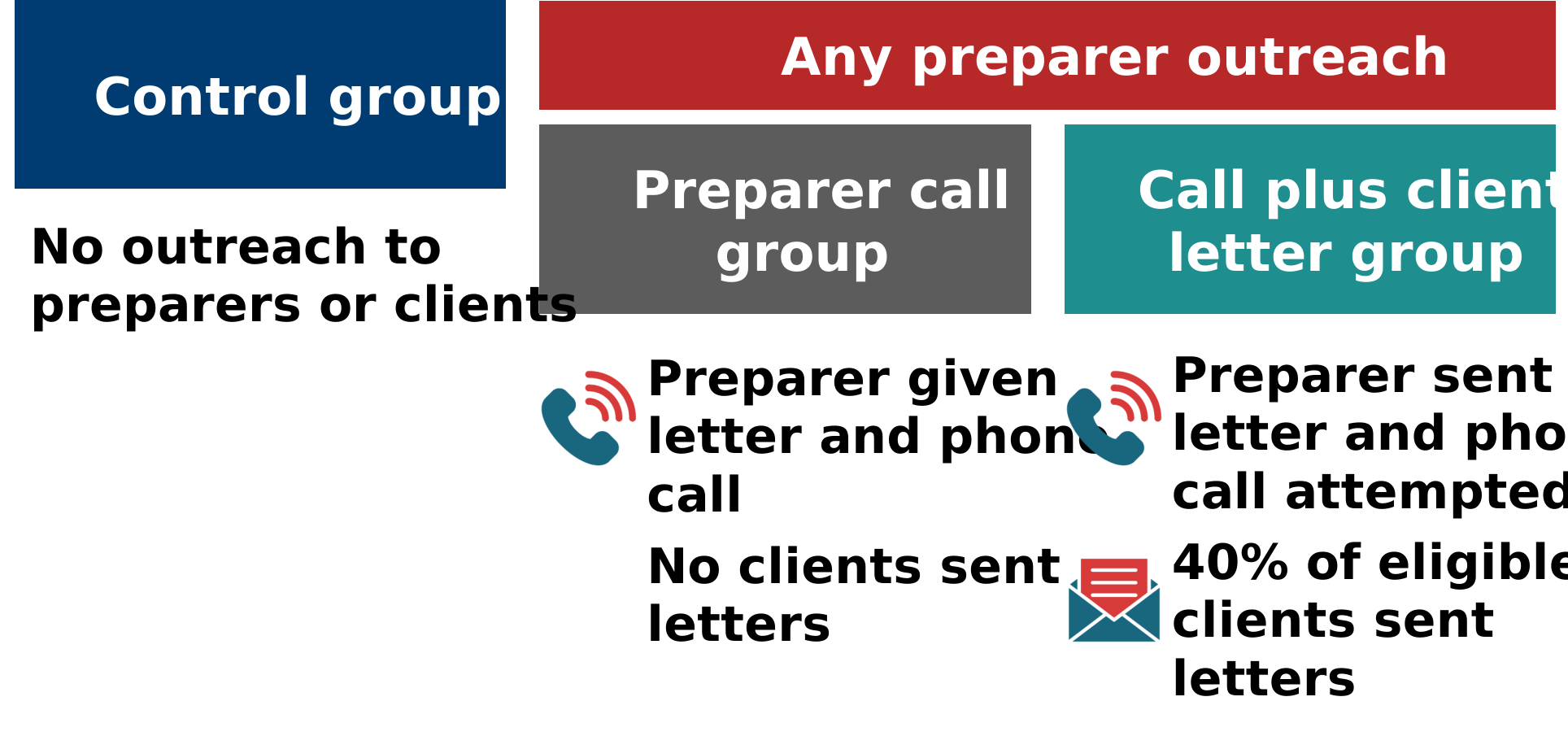
In the Preparer Outreach evaluation, we randomized tax preparers into one of three outreach groups: (a) a control group with no outreach to preparers or their clients (n = 392 preparers, 6,961 clients); (b) a group in which preparers were sent a letter informing them that they would receive a phone call from the IRS, followed by an attempted call (the “preparer call” group, n = 295 preparers, 5,301 clients); and (c) a group in which the preparers were given the same letter and call as above, and 40% of their eligible clients were randomized to be sent the client letter (the “call plus client letter” group, n = 300 preparers, 5,364 clients).2
Figure 2
Preparer Outreach Randomization Procedure
We used administrative data maintained by the IRS, plus tax return-level data processed by the IRS’s Taxpayer Services Division, to construct our outcome measures. The primary outcomes were (a) the dollar amount of refunds returned to the clients, and (b) the dollar amount of EITC, ACTC, and AOTC that were likely claimed erroneously.3 These are both measured at the end of the 2025 tax filing season.4 We estimated effects separately for clients in the Client Letter and Preparer Outreach evaluations.
What We Learned
We found that mailing the client letter reduced the amount of likely erroneous tax credit dollars claimed by clients who were sent the letter by an average of $209. However, there were no effects on clients who were not sent the letter (spillover clients), regardless of the share of a preparer’s clients who were sent letters. These results indicate that the client letter must be sent directly to clients to affect behavior, limiting opportunities for cost savings through spillover effects. We found no impact of letters and phone calls directed at preparers. Combining preparer outreach with client letters reduced likely erroneous tax credit dollars. These results fall just shy of thresholds for statistical reliability; nevertheless, they imply that pairing outreach to preparers with outreach to their clients may be more effective than preparer outreach alone.5
Client Letter Evaluation Results
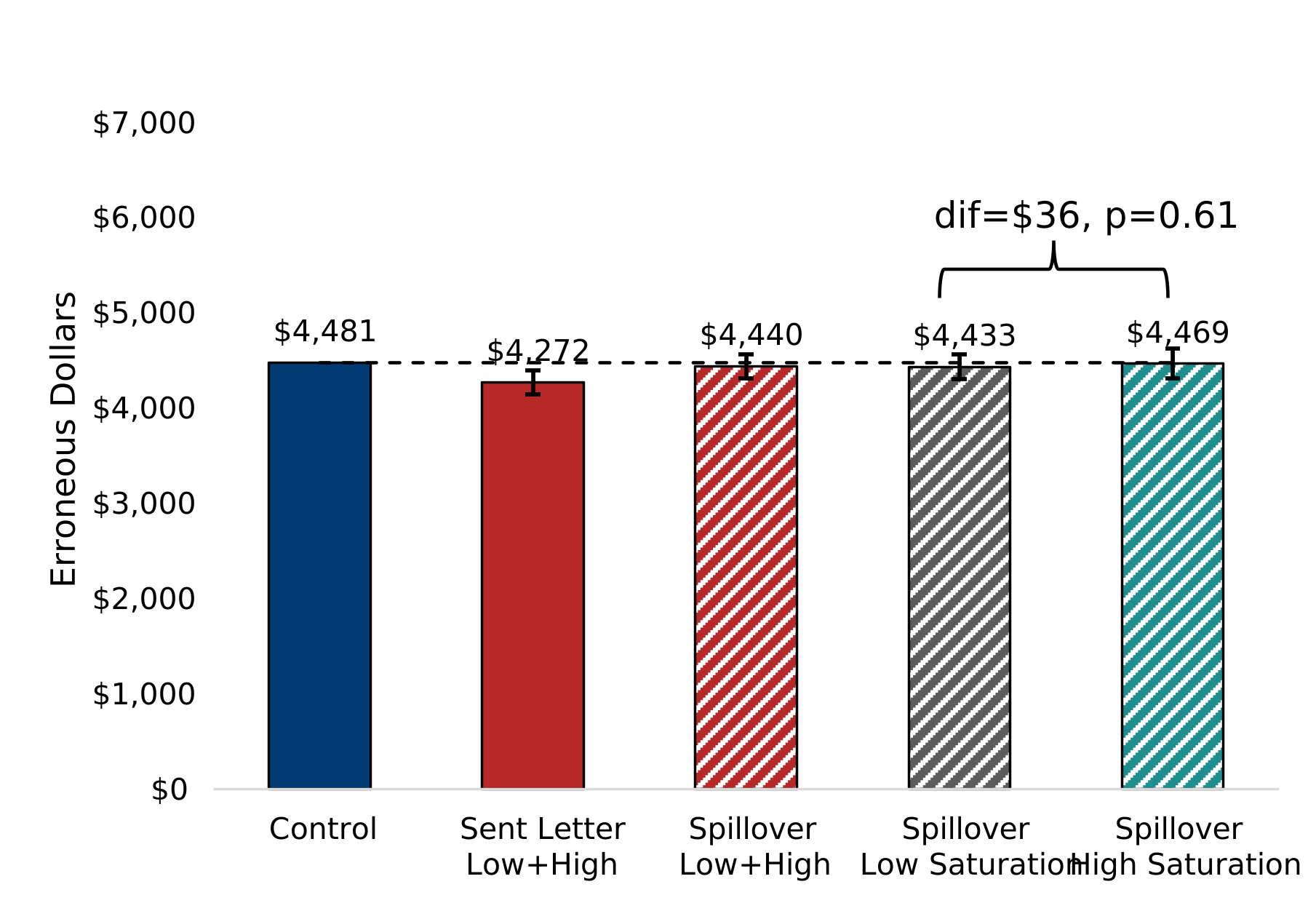
Clients who were sent a letter saw a reduction in erroneous dollars claimed of $209, a 4.7% reduction from the control mean of $4,481 (p < 0.01, 95% CI [-333, -86]).6 They also saw a reduction in refund amount of $129, a 2.4% reduction from the control mean of $5,447. While this result is statistically significant on its own (p = .014, 95% CI [-233, -26]), it does not remain significant after adjusting for multiple comparisons.7
We found no evidence of spillover effects on clients who were not sent a letter. Spillover clients saw a statistically insignificant reduction in erroneous dollars of $41 (p = .51, 95% CI [-165, 83]). Among spillover clients in the high saturation group, there was an insignificant decrease in erroneous dollars of $12 (p = .88, 95% CI [-169, 144]), while among spillover clients of preparers in the low saturation group, there was an insignificant decrease in erroneous dollars of $48 (p = .47, 95% CI [-178, 82]). There was no significant difference in spillover effects between the high and low saturation groups (p = .61). There were also no statistically significant impacts on refund amount for spillover clients.
Figure 3
Letter 6138 Reduced Erroneous Dollars Among Clients In The Client Letter Evaluation, But Only For Clients Who Were Sent The Letter Directly
Preparer Outreach Evaluation Results
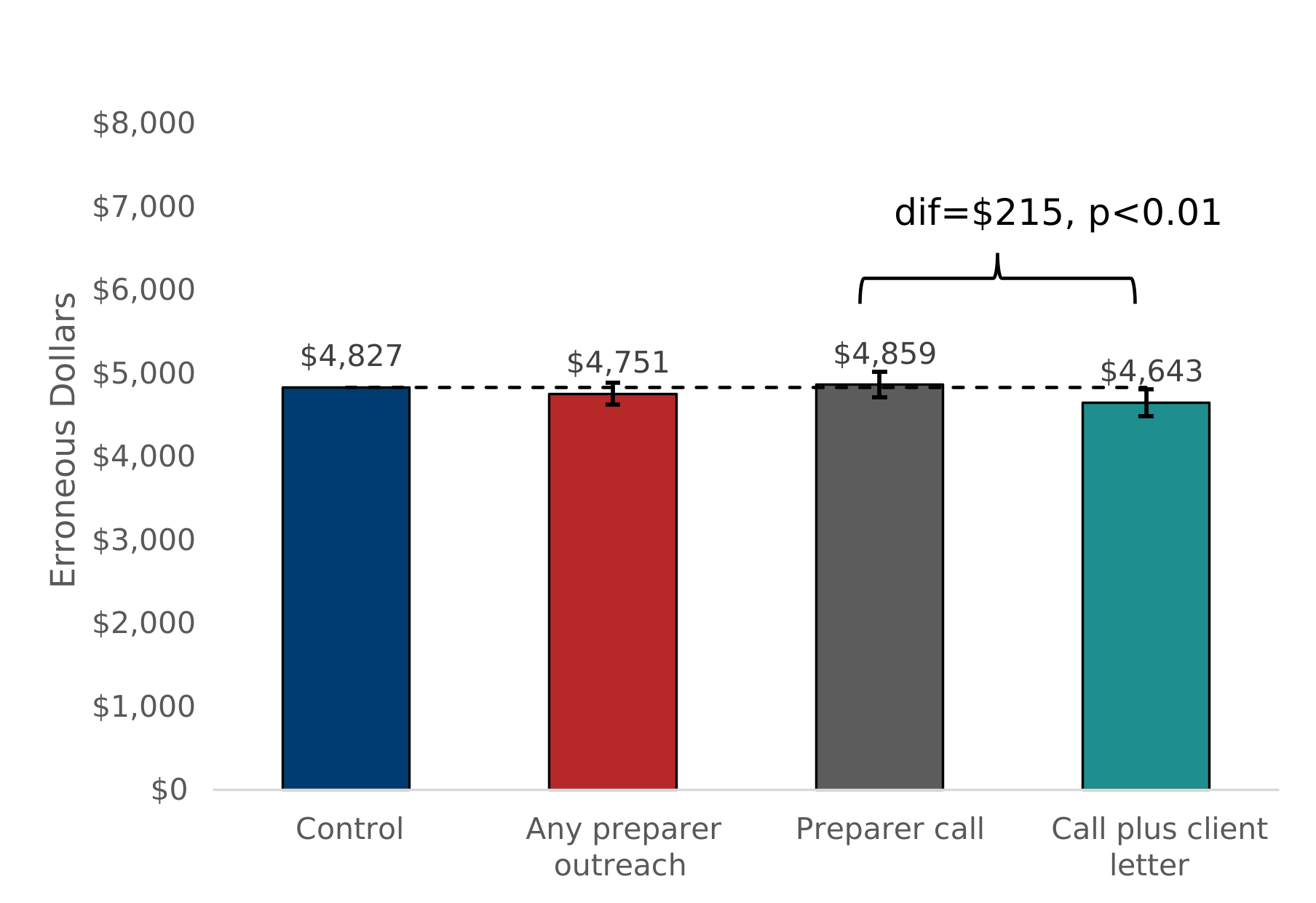
Contacting preparers directly via a letter and a phone call did not affect erroneous dollars claimed by their clients. These clients saw a statistically insignificant increase in erroneous dollars claimed of $31, from a control mean of $4,827 (p = .68, 95% CI [-119, 183]). However, the preparer outreach in combination with the client letters reduced erroneous dollars claimed by 184,a3.8%reduction(p=.03,CI[-346,-21]).Thedifferencebetweentheseestimates(215) was significant (p = .009), although neither estimate remains statistically significant after accounting for multiple comparisons.8 There were no statistically significant effects on refund amounts.
Figure 4
A Combination Of Outreach To Preparers And Client Letters Showed A Potential Reduction In Erroneous Dollars For Clients In The Preparer Outreach Evaluation
Applying the Findings
Our findings show that direct outreach to clients of high-risk tax preparers is a reliable way to reduce erroneous tax credit claims.
We find no evidence of spillover effects on clients not sent letters. This contrasts with large spillover effects observed in our previous evaluation, indicating that spillover effects may depend on letter content, implementation, or the characteristics of the preparers and clients involved. As a result, spillovers (and resulting cost savings) should not be assumed when designing outreach strategies, and further analysis is needed to understand when they may arise.
Similarly, our finding of no impact from outreach to preparers contrasts with positive results from two evaluations (in FY2021 and FY2025) of preparer outreach in the form of a pre-filing season letter sent to preparers. So it may be that the form or content of the outreach changes its effectiveness; further evaluation is needed to fully understand these discrepancies.
Notes:
- Clients who had not had likely errors in their own returns were not eligible for letters.
- Around 20% of calls are successful.
- Errors can only be confirmed via an audit, which is outside the scope of this evaluation. The IRS identifies likely errors probabilistically based on common sources of error.
- Unless noted otherwise, all of the analysis reported in this summary was prespecified in an analysis plan.
- An IRS internal report on this project gives different numbers than what is presented here, as that report used a different unit of analysis and different regression specifications.
- This result remains significant after adjusting for multiple comparisons. To keep the family-wise error rate (FWER) below 0.05, statistical significance is evaluated at α = 0.009.
- Adjusted α (controlling FWER at 0.05) = 0.009.
Verify the upload date of our analysis plan on GitHub.