


Increasing Engagement with Small Manufacturing Businesses’ Marketing Materials through Standardization

Man in jacket holding binder of materials
Summary
- Small manufacturing businesses sometimes struggle to engage in the federal marketplace. To market themselves for government contracting opportunities, small businesses often use capabilities statements. These are PDF documents with descriptions of the firm’s core strengths and prior experience, showcasing the firm’s services to federal buyers.
- In this evaluation, we tested whether redesigning capabilities statements using a template and proactively sharing them with federal buyers led to greater buyer engagement–essentially, whether the new format better captured buyers’ attention. We found that proactively sharing the templated capabilities statements via email made no difference in federal buyer engagement, measured by whether buyers clicked to view and/or submitted the form.
- Overall, emailing federal buyers with templated capabilities statements may not be an effective strategy for improving small business marketing, and alternative methods of reaching federal buyers for evaluations should be explored.
Agency Priority
The U.S. Small Business Administration (SBA) is committed to supporting small manufacturing businesses in the federal marketplace as they compete for contract awards. This evaluation was designed to provide evidence on whether templated capabilities statements, shared with federal buyers proactively, can enhance small businesses’ marketing efforts.
While the SBA recommends that small businesses market themselves to federal buyers, there is a lack of evidence on the most effective approaches. A capabilities statement is a valuable tool for summarizing a firm’s strengths and experience, but it can take a variety of formats. Some firms have more marketing capacity than others, and it is unclear whether capabilities statement design influences the firm’s success in the federal marketplace.
The lack of evidence on effective marketing strategies is particularly challenging for small businesses, which often have fewer marketing resources than large firms. This evaluation is designed to address the evidence gap by developing a capabilities statement template and testing the impact of proactively sharing templated capabilities statements via email on federal buyers’ engagement.
How We Evaluated
Our background research analyzing 4,546 capabilities statements from the SBA’s Dynamic Small Business Search system (now Small Business Search) found that roughly half were over two pages, while only a third described past performance on the first page. Meanwhile, several of the federal buyers we interviewed noted the importance of highlighting past performance. We created a capabilities statement template, incorporating existing guidance from the SBA, insights from interviews with federal buyers, and principles of visual design. Working alongside SBA Business Opportunity Specialists, Procurement Center Representatives, District Liaisons, and 21 small manufacturing businesses, we co-created updated capabilities statements for each of the firms using the template. We used public data on federal contract opportunities to gather contact information for a sample of 32,759 federal buyers, and then proactively emailed them from December 1-11, 2025.
In these emails, we randomized whether the federal buyer was shown a firm’s original capabilities statement or the updated one co-designed with OES. The email included an image of the capabilities statement and a link to an interest form, which displayed the capabilities statement and asked buyers if they would like to receive additional information about the firm. The main outcomes were clicks to open the interest form (click rate) and requests for additional information (submit rate) received by December 19, 2025, both of which indicate federal buyers’ engagement.
What We Learned
There was no statistically significant difference in federal buyers’ engagement with the updated vs. original capabilities statements proactively shared via email.
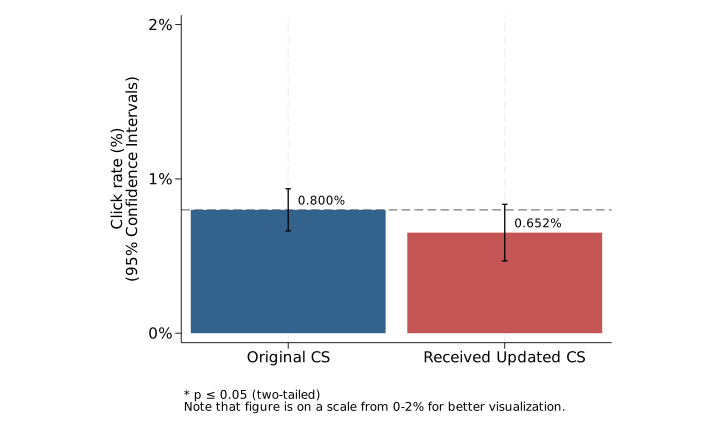
Among the 32,759 federal buyers in our sample, only 238 (0.73%) clicked on the interest form. As shown in Figure 1, the federal buyers who received an email with an updated capabilities statement had a click rate of 0.65% compared to 0.80% of those shown an original capabilities statement. This represents a statistically insignificant decrease in click rates of 0.15 percentage points among federal buyers shown an updated capabilities statement (p = 0.115, 95% CI [-0.33, 0.04]).
Figure 1
The Updated Capabilities Statement (Received Updated CS) Had No Effect On The Number Of Federal Buyers Who Clicked To View The Interest Form
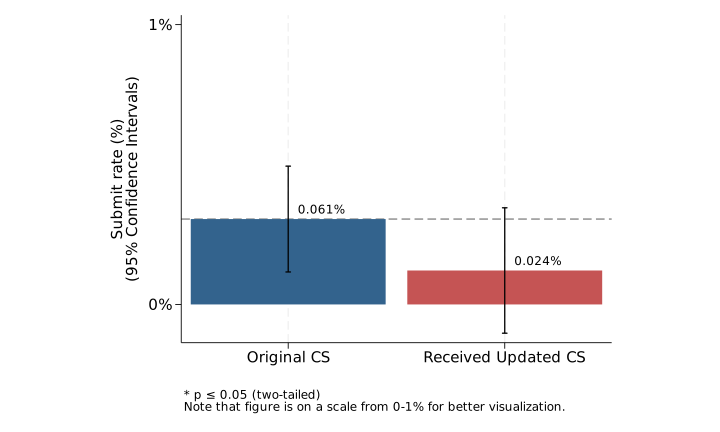
Form submission rates were lower than click rates, with only 14 buyers (0.04%) ultimately submitting the interest form. As shown in Figure 2, 0.024% of federal buyers shown an updated capabilities statement submitted the form compared to 0.061% who were shown an original capabilities statement, a non-significant difference of -0.037 percentage points (p = 0.108, 95% CI [-0.082, 0.008]).
Figure 2
The Updated Capabilities Statement (Received Updated CS) Had No Effect On The Number Of Federal Buyers Who Submitted The Interest Form To Receive Additional Information About The Firm
In exploratory analysis, we considered several subgroup analyses. We only observed differential engagement rates among buyers who received the original capabilities statement. Specifically, higher click rates were observed for buyers whose location matched that of the firm (compared to non-location-matched). Significantly lower click rates were observed for: (1) buyers whose posted opportunities matched to the firm’s primary NAICS (compared to those whose posted opportunities did not match a firm’s primary NAICS); (2) buyers who had posted an opportunity in a manufacturing NAICS in which the firm works (compared to those who had not); and (3) buyers with a DoD email address (compared to those who did not have a DoD email address).
Finally, we received “undeliverable” notices and particular auto-replies, suggesting that at least 4% of emails did not reach a buyer (for example, because the email address was no longer active or the recipient was no longer in their position). The true rate is likely higher.
Applying the Findings
We found no statistically significant effect of the email with the updated capabilities statement template on federal buyers’ engagement. However, there are lessons learned from this intervention that can be applied to future work.
The extremely low engagement rate across all federal buyers, regardless of whether original or updated capabilities statements were presented, suggests that unsolicited emails may not be an effective outreach strategy for connecting small businesses with federal buyers. The less than 1% engagement observed in this study is lower than the engagement rate we observed in another recent OES-SBA evaluation, which found an engagement rate of almost 5% with emailed content among federal buyers. Our findings suggest that large-scale cold email outreach to federal buyers has limits as a marketing strategy for firms interested in the federal marketplace. Instead, it could be valuable to explore the effectiveness of other outreach methods, such as asking for facilitated introductions through existing procurement networks, relying on integration with procurement platforms, and conducting smaller-scale targeted outreach tailored towards federal buyers’ early-stage procurement needs. In cases where emails are used as the outreach method, future work should prioritize the subgroups of buyers (e.g., location-matched) this study’s exploratory analyses identified as having higher email engagement.
However, in addition to being used by firms as a marketing tool, capabilities statements also play an important role in providing information about firms to federal buyers. While the updated capabilities statements did not increase engagement, it is possible that having the capabilities statement image embedded in the email allowed federal buyers to digest information about firms more efficiently, and these buyers were thus better able to filter out firms that are poor fits. Future work could embed qualitative data collection to understand how capabilities statements are perceived by buyers.
Moreover, the lack of impact observed in this study may be partly attributable to contextual factors, first and foremost emailing federal buyers during a period of significant change in the federal marketplace. Federal buyers were adapting their acquisition strategies in accordance with the Revolutionary FAR Overhaul and broad consolidation of federal procurement under the President’s Management Agenda. In addition, we emailed federal buyers following a year of staff departures, post-government shutdown, and during the holiday season. Future studies in the procurement context should continue to consider these and similar external factors. Compounding the likely high rate of undeliverable messages due to staff departures, the emails in this study were manually sent via a mail merge, which does not capture the precise rate of undeliverable emails. Future studies should consider a web-based platform (e.g., Qualtrics) to automate email sending and reliably tracktrack engagement metrics, such as deliverable rates.
Verify the upload date of our Analysis Plan on GitHub.