


Reducing Reporting Errors via Outreach and Education to Tax Preparers

Tax form next to calculator
Summary
- This evaluation is the latest in a series of evaluation partnerships between OES and the IRS, designed to improve the efficacy of the IRS’s tax compliance outreach. The goal of this evaluation was to assess the relative effectiveness of different modalities of outreach in improving tax compliance among professional tax preparers.
- We found that a pre-filing season letter coupled with eligibility for a filing-season call or a letter significantly reduced total refund amount and total erroneous dollars claimed. An invitation to a webinar had no effect.
- We estimate that these low-cost outreach efforts saved the federal government $228.9 million.
Agency Priority
In 2023, the Internal Revenue Service (IRS) estimated that there were over $24 billion dollars in overpayments from three high-priority refundable tax credit programs: the Additional Child Tax Credit (ACTC), American Opportunity Tax Credit (AOTC), and the Earned Income Tax Credit (EITC). Individual tax filers (“clients”) often use paid tax return preparers to help prepare their returns. The IRS, through their Return Integrity and Compliance Services - Return Preparer Strategy (RPS), aims to reduce overclaiming of refundable tax credits and other benefits by tax preparers through education and outreach. In a previous evaluation, we found that letters sent to preparers during the pre-filing season were effective in reducing filing errors related to refundable tax credits. The purpose of this evaluation was to build on learnings from the previous evaluation to further increase the effectiveness of outreach efforts.
How We Evaluated
We evaluated three outreach methods to understand which was most effective in reducing filing errors: an invitation to a webinar, two letters, or a letter followed by a phone call. The two letters notified the preparers that the IRS had detected potential errors in returns the preparer had submitted, and provided information on how to meet requirements and avoid penalties. The webinar contained the same information as the letter, but in greater depth. The phone call allowed for a one-on-one discussion with IRS staff that could provide more individualized information than letters or webinars.
We evaluated these approaches with a preparer-level randomized control trial. Preparers who had enough probable errors during the previous tax season to qualify for the RPS were randomized to one of four outreach groups: a control group with no outreach or education (n = 1,811 preparers); a group invited to a webinar during the pre-filing season (n = 2,025 preparers); and two groups who each were sent an educational letter prior to the filing season.1 One of these groups, the letter + letter group (n = 1,411), was sent a similar letter during the filing season if they accrued enough errors during the filing season. The second, the letter + call group (n = 3,788), received a phone call if they accrued enough errors during the filing season.2
We analyzed how each of these outreach methods affected the preparer’s tax compliance (the accuracy of the returns they prepared). We estimated the effect separately for two groups of preparers: “new” preparers, or preparers who had received limited past outreach from the IRS, and “returning” preparers, or preparers who had regularly committed filing errors and had received outreach from the IRS in recent filing seasons.
We used administrative data maintained by the IRS, plus tax return-level data processed by the IRS’s Taxpayer Services Division, to construct our outcome measures. The primary outcomes were: (a) the total dollar amount of all refunds returned to the tax filers who used the preparer and (b) the total dollar amount of EITC, ACTC, and AOTC that may have been claimed erroneously. Both are measured at the end of the 2025 tax filing season using data from tax year 2024 returns.3,4,5
What We Learned
We found that the pre-filing season letter + call intervention resulted in lower total refund amounts and lower total erroneous dollar amounts claimed among both new and returning preparers. Estimated effects of the letter + letter intervention were similar in magnitude to the letter + call, but fall short of the threshold for statistical significance after adjusting for multiple comparisons. A test of the differences between letter + call and letter + letter treatments showed no statistical difference. The webinar had no statistically significant effects.6
We found no impact of letters and phone calls directed at preparers. Combining preparer outreach with client letters reduced likely erroneous tax credit dollars. These results fall just shy of thresholds for statistical reliability; nevertheless, they imply that pairing outreach to preparers with outreach to their clients may be more effective than preparer outreach alone.
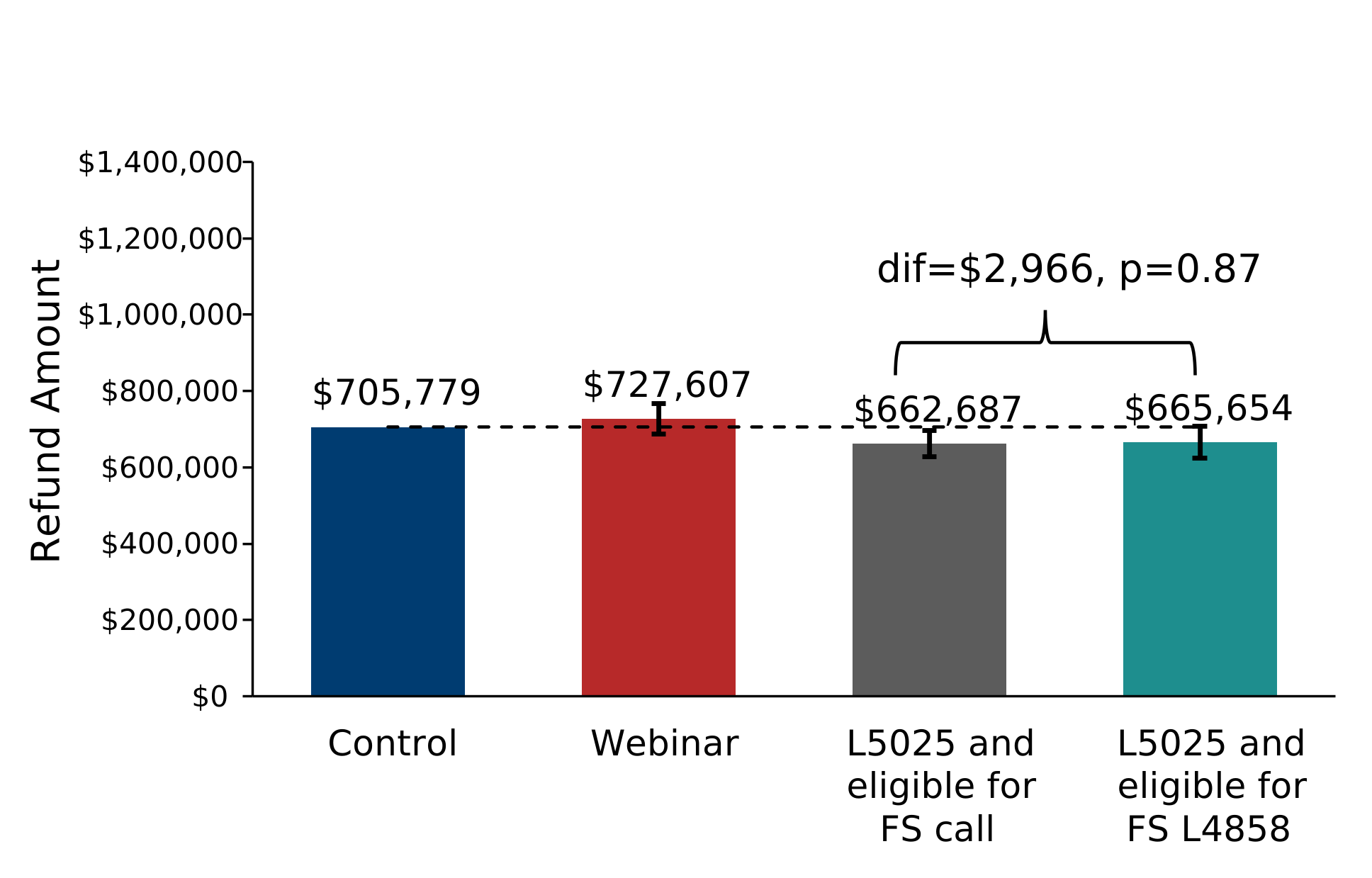
Among new preparers, the letter + call treatment resulted in a reduction in total refund amount of $43,092, relative to a control group mean of $705,799. This result is statistically significant on its own (p = .02, 95% CI [-77,814, -8,368]), but it does not remain significant after adjusting for multiple comparisons.7 Sending the pre-filing season letter plus eligibility for the filing season letter (letter + letter) reduced the total refund amount by $40,125 (p = .06, 95% CI [-82,383, 2,132]), falling just short of statistical significance. The difference in impacts between the letter + letter treatment and the letter + call treatment is not statistically significant (p =0.87). Inviting preparers to the webinar increased their refund amount by $21,828, but this is not statistically significant (p = .28, 95% CI [-17,761, 61,416]).
Figure 1
A Pre-filing Season Letter Plus a Filing Season Call Reduced Total Refund Amount by $43,092 Among New Preparers
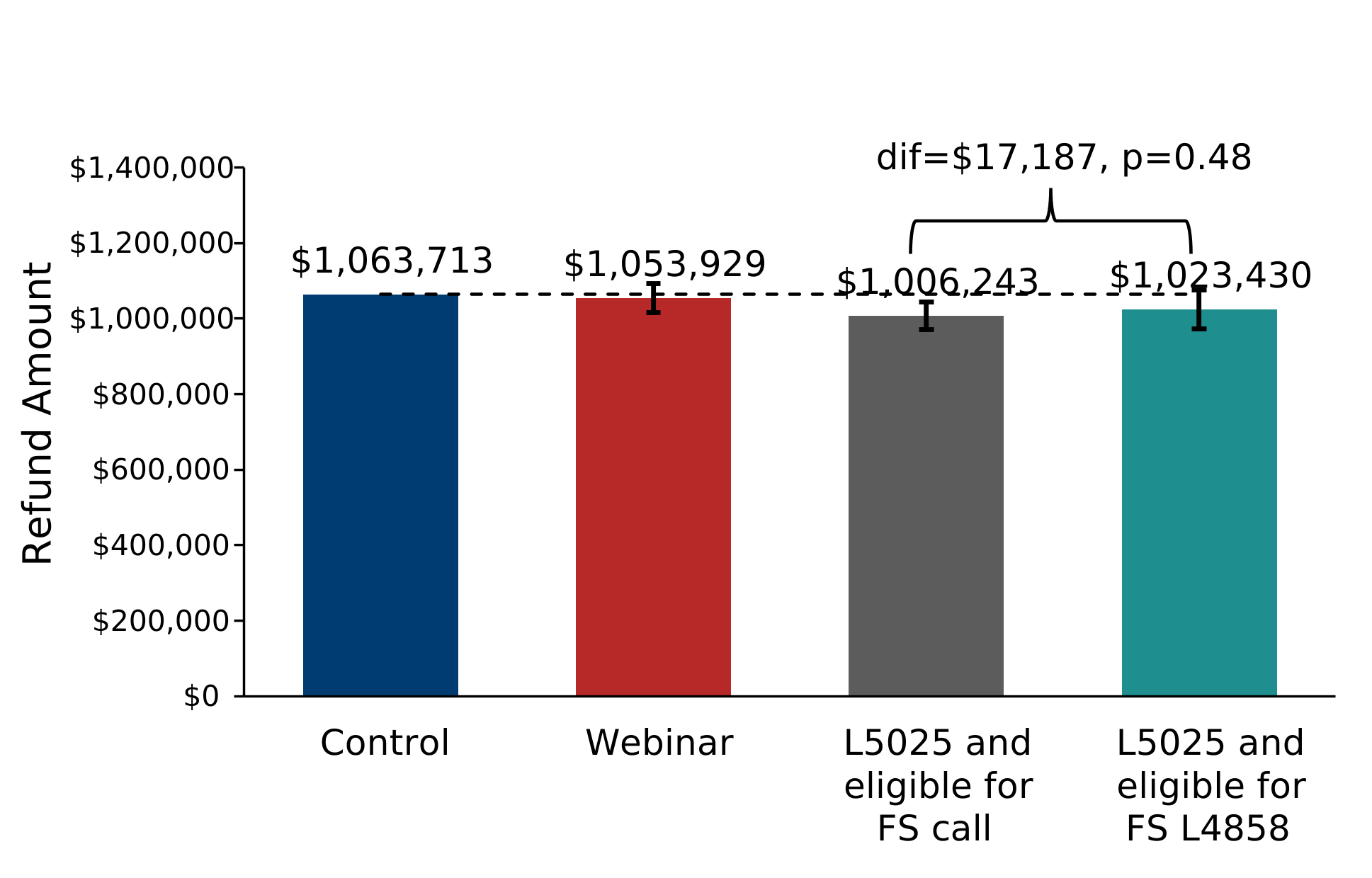
Among returning preparers, sending the pre-filing season letter plus eligibility for the filing season call reduced the total refund amount by $57,470 relative to the control group mean of $1,063,713 (p = .002, 95% CI [-94,105, -20,834]).8 Sending the letter plus eligibility for the filing season letter reduced the total refund amount by $40,283 (p = .13, 95% CI [-92,204, 11,638]), but this result is not statistically significant. There was no statistically significant difference between the impacts of the two interventions (p = .48). Inviting the preparers to the webinar reduced total refunds by $9,784, but this result is not statistically significant (p = .62, 95% CI [-48,947, 29,378]).
Figure 2
A Pre-filing Season Letter Plus Filing Season Call Reduced the Total Refund Amount by $57,470 Among Returning Preparers
We found similar results when assessing total erroneous dollars claimed. Among new preparers, the letter + call intervention resulted in a reduction in total erroneous dollars of $25,908 relative to a control mean of $248,242 (p = .002, 95% CI [-41,917, -9,897]).9 The letter + letter intervention reduced total erroneous dollars by $19,211 (p = .06, 95% CI [-39,119, 698]), falling just short of statistical significance. Among returning preparers, letter + call reduced total erroneous dollars claimed by $17,903 relative to a control mean of $240,078 (p = .003, 95% CI [-29,868, -5,937]).10 The letter + letter treatment reduced total erroneous dollars among returning preparers by 15,540(p=.054,95%CI[-31,338,258]);thisresultalsofallsshortofstatisticalsignificance.11Forbothnewandreturningpreparers,therewerenostatisticallysignificantdifferencesbetweentheletter+letterandletter+callgroups(newpreparersp=.43;returningpreparersp=.74),andtheinvitationtothewebinarhadnoeffect(newpreparersβ=8,488, p = .38, 95% CI [-10,257, 27,232]; returning preparers β=$223, p = .97, 95% CI [-12,890, 13,337]).
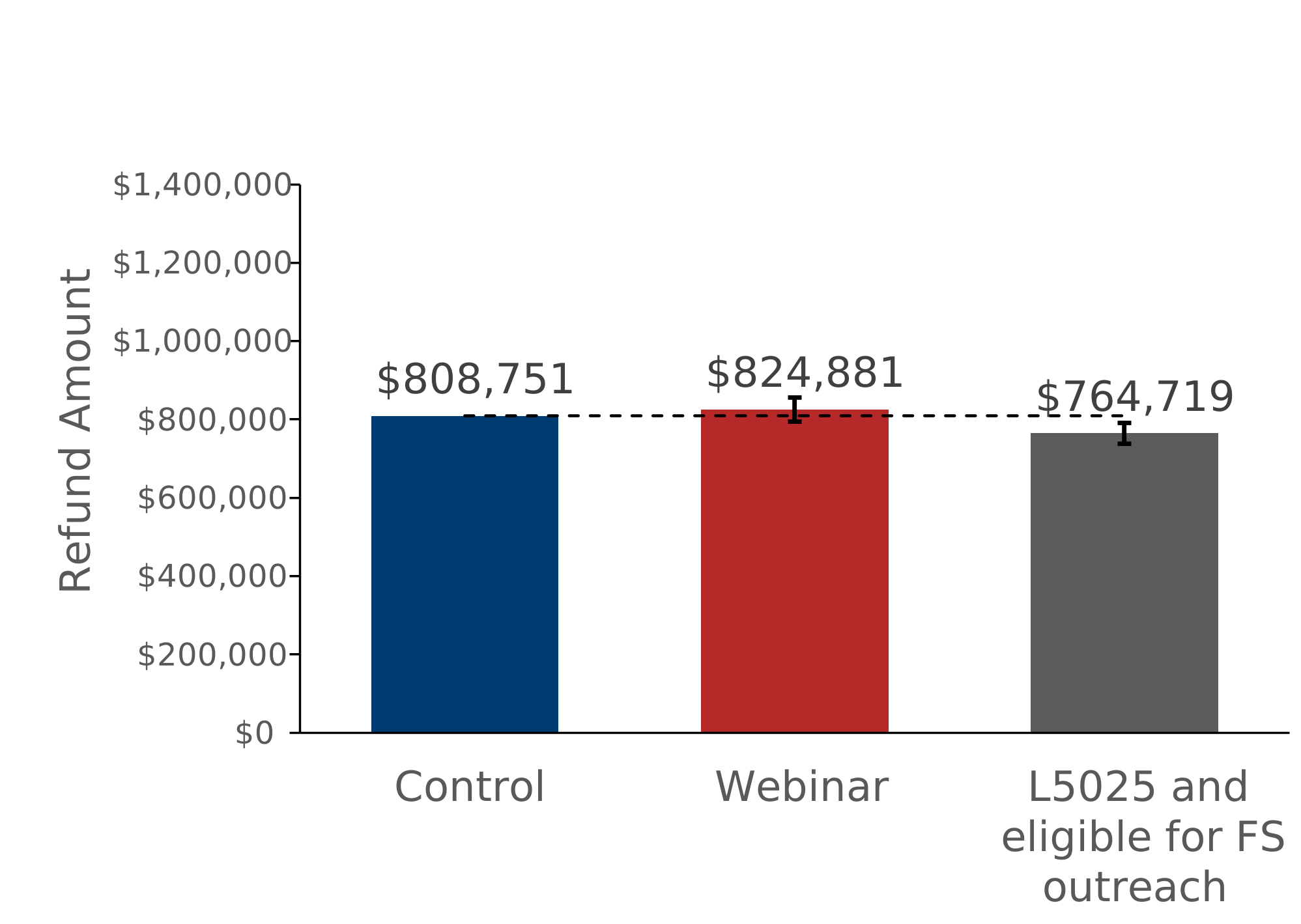
Though not part of our preregistered analyses, the value of this outreach became more clear when we analyzed new and returning preparers together, and combined letter + call and letter + letter interventions. We found that sending the pre-filing season letter and either sending a second letter or calling preparers who continued to make errors during the filing season reduced the total refund amount claimed by either new or returning preparers by $44,032 on average, relative to a comparison group mean of $808,751 (p = .001, 95% CI [-70,339, -17,725]).12
Figure 3
The Letter Plus Filing Season Call or Letter Reduced the Total Refund Amount by $44,032 Among New and Returning Preparers
Applying the Findings
We estimate that sending the pre-filing season letter plus eligibility for the filing season call or letter results in cost savings of $228.9 million, based on a reduction in refund amount of $44,032 among 5,199 treated preparers.
Results from this evaluation show that the pre-filing season letter, when paired with eligibility for either a filing season letter or a phone call, is effective at reducing the costs of potentially erroneous tax returns. A statistical test comparing impacts of eligibility for the filing season calls with the impacts of eligibility for letters did not show a significant difference in their effectiveness. Given this finding, and considering that phone calls may be more expensive to implement, letters may be a more cost-effective form of compliance outreach. We recommend further analysis of the cost-effectiveness of each approach. An invitation to a webinar is not effective, at least among the segment of preparers selected for this treatment in FY2025.
In our 2021 evaluation of outreach to high-risk task preparers, we were not able to isolate whether following the pre-filing season letter with eligibility for a filing season letter or phone call was more effective, as this second-stage outreach was not randomized. This evaluation thus builds on the 2021 results by randomizing the second outreach modality, allowing for a clean comparison of the impacts of eligibility for the filing season letters and calls. It also expands on the 2021 evaluation by examining the impacts of the invitation to the webinar, which were not previously included.
Results from this evaluation highlight how different types of tax return preparers (i.e., new and returning preparers) respond differently to outreach efforts. Unlike our previous work, in which we found no effects for returning preparers, here we find that outreach is effective for both groups. Future work could explore what characteristics of preparers predict that they will respond to outreach interventions, allowing for a more tailored outreach approach.
Notes:
- Approximately 15% of those invited actually attended the webinar.
- Preparers in both the letter + letter and letter + call groups only received the second intervention if they reached a certain threshold of errors during the filing season. We randomized eligibility for these second interventions, and analysis thus looks at the impacts of eligibility, since intervention receipt is endogenous.
- Errors can only be confirmed via an audit, which is outside the scope of this evaluation. The IRS identifies likely errors probabilistically based on common sources of error.
- Unless noted otherwise, all of the analysis reported in this summary was prespecified in an analysis plan.
- These measures may overstate net savings if clients who purposefully file erroneous returns migrate to other preparers outside this sample.
- An IRS internal report on this project gives different numbers than what is presented here, as that report only showed results for new and returning preparers combined.
- To keep the family-wise error rate (FWER) below 0.05, statistical significance is evaluated at α = 0.010.
- This result remains statistically significant after controlling for multiple comparisons, using a family-wise error rate adjusted threshold of α = 0.009.
- This result remains statistically significant after controlling for multiple comparisons, using a family-wise error rate adjusted threshold of α = 0.010.
- Adjusted α (controlling FWER at 0.05): 0.009.
- Adjusted α (controlling FWER at 0.05): 0.009.
- This result remains statistically significant after controlling for multiple comparisons, using a family-wise error rate adjusted threshold of α = 0.007. The family for these adjustments was not pre-specified in our analysis plan but includes all coefficients related to letter outreach for new, returning, and pooled preparers.
Verify the upload date of our analysis plan on GitHub.